
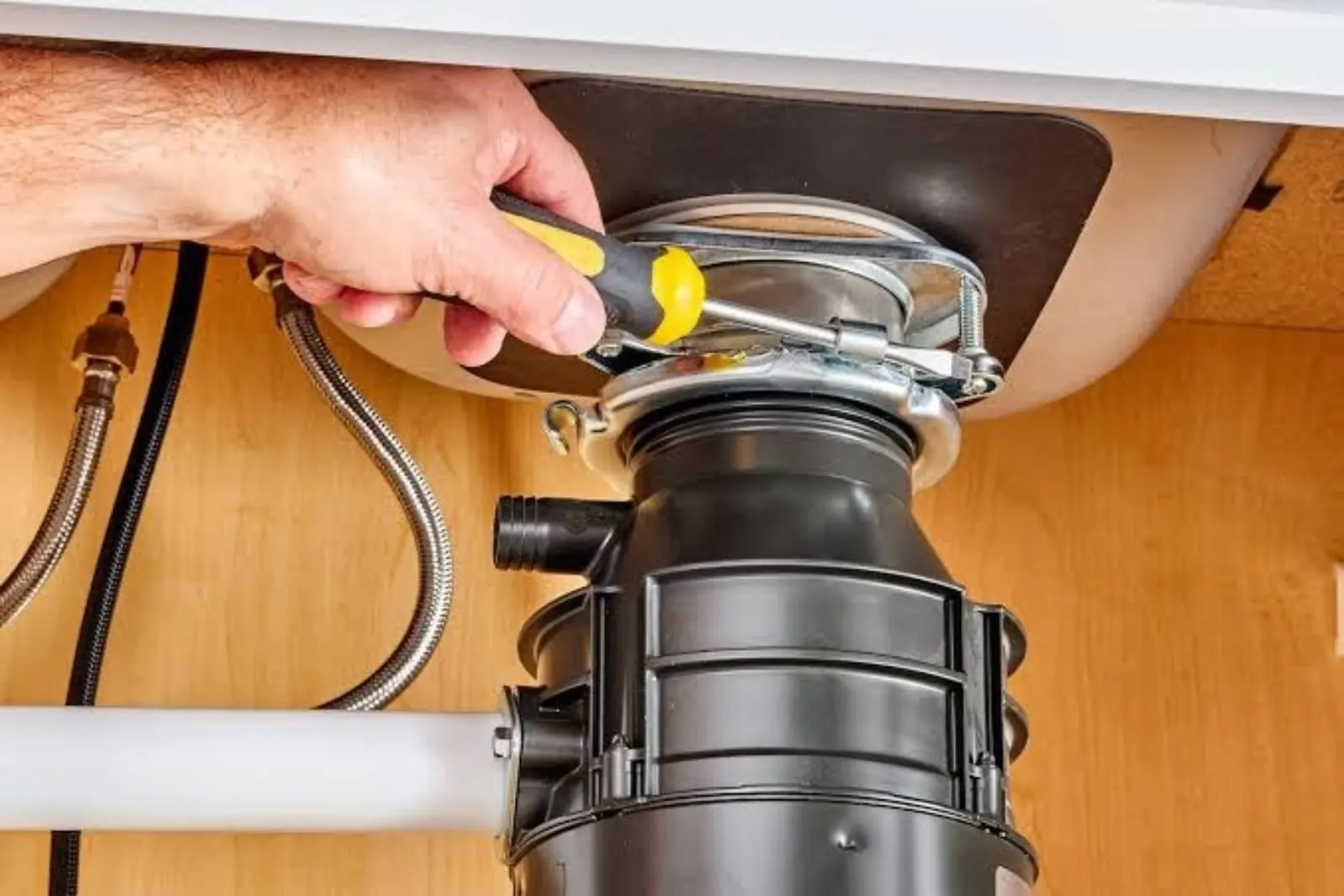
Three ways to power a disposal
Most disposals are either plugged into an outlet under the sink or hardwired to a junction box. Either way, a switch on the wall or on the counter turns the unit on and off. The switch is often a dedicated wall switch or a countertop air switch.
The right choice depends on what is already behind your sink and how the cabinet is wired.
What each option requires
| Setup | What you need | Notes |
|---|---|---|
| Plug-in disposal | Outlet under the sink on a switched circuit | Convenient for replacement. |
| Hardwired disposal | Junction box and cable | Cleaner look, more wiring. |
| Air switch | Countertop button and air tube | No wall wiring in the countertop. |
| Wall switch | Existing circuit and switch box | Standard approach. |
Safety limits to respect
A plumber installs the disposal and connects drain and dishwasher lines. New wiring is electrical work, and we coordinate with an electrician when it is needed.
- Turn off the breaker and test the wires before touching them.
- Kitchen outlets near water need ground fault protection.
- Do not run an extension cord to a disposal.
- Do not reach into the disposal even when off.
- If you are unsure about wiring, hire a licensed electrician.
The plumbing side
A new disposal needs a sink flange and mounting, a discharge connection to the trap and a dishwasher knockout opened if the dishwasher drains through it. Forgetting to open the knockout is a common mistake, and the dishwasher will not drain. Our faucet and sink repair and garbage disposal repair teams handle the plumbing connection.
Choosing between a wall switch and an air switch
A wall switch is the standard choice, wired in the kitchen wall with the same kind of switch as a light. It is reliable, but it needs a path for cable from the switch to the sink cabinet. An air switch is a button on the counter or sink that sends a puff of air through a tube to a switch at the disposal.
The air switch can be a good fit where the wall is hard to open, such as tile or a finished backsplash. It does need a hole in the countertop or sink deck, and some people prefer not to add one.
What to check before installing a new disposal
These steps catch most of the problems we see on first-time disposal installs, such as a slow dishwasher drain or a leak at the flange.
- The horsepower and mounting type fit your sink and the trap arrangement.
- The dishwasher knockout is opened if the dishwasher drains into the disposal.
- The drain trap and discharge pipe align without strain.
- The power cord or hardwire connection meets the unit's instructions.
- The sink flange is sealed with plumber's putty or the sealant the maker names.
After installation
Run cold water, turn the unit on briefly and check under the sink for drips at every joint. Run the dishwasher and watch that water drains. A jam is common in new units, so keep the manufacturer's hex key for the underside of the unit, and never reach into the disposal.
If a unit hums but does not spin, see our garbage disposal repair page for next steps. Frequent jams may mean the trap or the drain beyond is partly blocked.
Common mistakes to avoid
Most of these are caught by a careful test run. Run water and the disposal for a full minute and then check every joint with a dry paper towel.
- Forgetting to remove the dishwasher knockout plug.
- Overtightening the mounting ring and cracking it.
- Leaving the power cord loose where it can touch water.
- Using the wrong switch rating for the circuit.
- Skipping a leak test with water running.
Using a disposal the right way
A disposal that is used well lasts longer and clogs less. The City of Florissant asks residents to keep grease and oil out of drains, and that includes disposals.
- Run cold water before, during and after each use.
- Feed scraps in slowly and not all at once.
- Skip grease, bones, fibrous vegetables and pits.
- Never put hands or tools in the disposal while it is on.
- Grind a few ice cubes now and then to clean the chamber.
Questions homeowners ask us
If you are replacing a unit that already has power and a switch, the job is mostly plumbing and takes less time.
Can any switch be used?
Use a switch rated for the circuit and the unit.
Does the disposal need its own circuit?
Many manufacturers recommend a dedicated circuit, so check the instructions.
Can I add a switch with no wall access?
An air switch may work in that case.
Who does the electrical part?
A licensed electrician handles new wiring, and we coordinate the visit.
What to know in Florissant
The City of Florissant lists electrical wiring and plumbing among residential work that requires permits, so new wiring for a disposal can involve a permit as well. Ask Public Works whether a simple outlet or switch addition qualifies.
The city also names grease, oils and wipes as things to keep out of drains. A disposal does not change that advice, and scraps that pass through it still head to the lateral.
Our crews handle disposal work in Hazelwood and Spanish Lake.
Source: City of Florissant services page.
Standards and sources
Where this page describes city rules, such as permits, lateral program terms and items to keep out of drains, the City of Florissant is the source. Terms can change, so confirm with the city before you act.
Sources: City of Florissant services page.
Local questions answered
Florissant lists electrical wiring among permitted work. Ask Public Works before you start.
We connect the plumbing and coordinate with a licensed electrician for new wiring.
A countertop button that sends a pulse of air to a switch at the unit, avoiding a wall switch.