
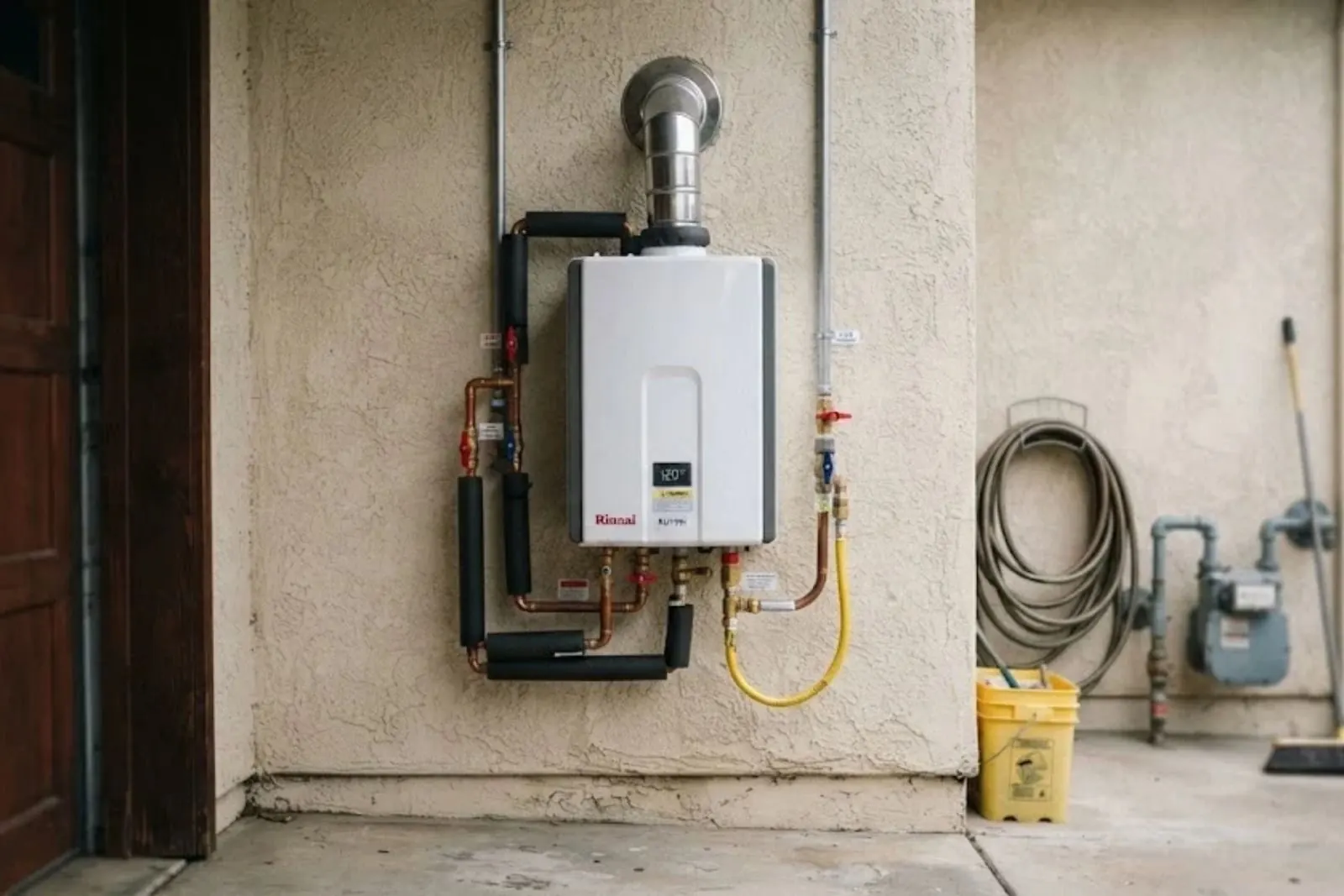
The price has four parts
A tankless quote has a unit price, an installation price, any gas or electrical upgrades and the permit. People comparing a tank with a tankless unit often look at only the first and are surprised by the others.
We will not name a number here because it depends on your house. We can explain what moves each part and give a written breakdown after a visit.
What moves the price up or down
Electric tankless units avoid gas and venting, but they can need large circuits that your panel may not have.
Unit capacity
A larger unit that serves more fixtures at once costs more.
Gas line size
Many tankless units need a bigger gas line than a tank does.
Venting
Sealed combustion venting runs through a wall or roof.
Condensate drain
High efficiency units need a safe drain for acidic water.
Tank versus tankless: ongoing costs
| Factor | Tank | Tankless |
|---|---|---|
| Upfront cost | Lower | Higher. |
| Standby heat loss | Yes | None. |
| Maintenance | Flush and anode check | Annual descaling. |
| Hot water supply | Limited by tank size | Limited by flow rate. |
Questions to ask every installer
Ask for the answers in writing. For a planned install, see water heater installation, and if a tank has failed see water heater replacement.
- Does the quote include the gas line, venting and permit?
- Which brand and capacity, and why that size for my fixtures?
- What is the warranty on parts and labor?
- Is a condensate drain included?
- What descaling schedule do you recommend?
The cost factors that decide your quote
The installed price comes from all four, not the sticker on the box. Ask any contractor to itemize the quote so you can compare like with like.
The unit
Size, brand and whether it is condensing change the equipment price.
Gas line
Many tankless units need a larger gas line than a tank heater.
Venting
Sealed venting and its length add materials and labor.
Water and drain work
Isolation valves, a condensate drain and a recirculation line add fittings.
Is tankless worth it for your house
Tankless units can last longer than tanks, but they need flushing, and the savings depend on how you use hot water. We explain both sides on our tankless water heater page.
| Situation | Tankless fit | Why |
|---|---|---|
| Large household, long showers | Good | Endless hot water on demand. |
| Small household, short use | Mixed | Savings take longer to show. |
| Hard water, no softener | Needs care | Scale shortens heat exchanger life. |
| Tight space or no gas line | Often electric or tank | Install changes the cost. |
Questions to ask about maintenance
The answers matter as much as the price. A unit installed without flush valves is harder and costlier to maintain for years.
- How often should it be flushed in hard water?
- Does the install include isolation valves for flushing?
- What does the warranty cover on the heat exchanger?
- Who services it when it throws an error code?
Financing and long-term view
The upfront price of a tankless system is higher than a tank, so look at the whole life of the unit. A tank heater may be replaced once or twice in the span a tankless unit serves, and a tank uses fuel to keep water hot all day. These factors can narrow the gap, but they do not always close it.
Ask for a written estimate that lists the unit price, installation, any gas or electrical upgrades and the warranty terms. Compare that with the price of a replacement tank of the right size, and weigh your own hot water habits. We are happy to give you both numbers in one visit.
Electric and gas tankless units
Gas tankless units move a lot of heat and need venting and a good gas supply. Electric tankless units need very high amperage, and many panels cannot supply it without an upgrade. A whole-house electric unit can be a larger electrical project than it first appears.
Point-of-use electric units under a single sink avoid some of that load, and they suit a small, distant fixture. We explain which type matches your house before you choose, and we check your panel and gas line on the visit.
Upgrades that sometimes come with the install
Not every house needs all of these, and we point out which ones apply. Knowing them in advance makes the quote believable, because the price shown is the price you pay.
- A larger gas line or a new gas regulator.
- A dedicated electrical circuit.
- A condensate drain or pump.
- A recirculation line or small buffer tank.
- A water softener or filter to protect the heat exchanger.
What to know in Florissant
Missouri American Water's 2023 report lists total hardness of 82 to 226 ppm at its Missouri River plants, roughly 5 to 13 grains per gallon. A tankless heat exchanger collects scale, so a yearly descaling visit is part of the cost of owning one here, and a softener upstream can reduce it.
The City of Florissant lists water heater replacement among residential work that needs a permit through Public Works, so the permit belongs in any quote you receive.
The same quote questions apply for installs in Hazelwood and Ferguson.
Sources: Missouri American Water 2023 water quality report and City of Florissant services page.
Standards and sources
General information on tank and tankless water heater types, efficiency and temperature settings is published by the U.S. Department of Energy. Permit rules for water heater work come from the local building office, and the City of Florissant lists plumbing among residential projects that need a permit.
Sources: U.S. Department of Energy Energy Saver guide to water heating and City of Florissant services page.
Local questions answered
The city lists water heater replacement as permitted residential work. Ask us to include it.
It depends on use. Savings come from no standby loss, but upfront cost is higher.
Scale builds up. Flush annually.